Text written by Rikke Rosenberg, curator at Danish Museum of Art and Design.
Printed in a catalogue in connection with the soloexhibition “Place for a Secret”, 2008 at the Danish Museum of Art and Design. 


Place for A Secret

Gitte Jungersen (b.1967) was educated at Danmarks Designskole from 1988 until 1993. She was awarded the Danish National Art Foundation’s 3-year working grant, a prestigious honor, in the year 2000. Jungersen is an active participant on the scene of younger experimental ceramists. She has been making an impact with solo shows and group shows, in Denmark and abroad. 

In synch with other younger Danish and international ceramists and contemporary artists, Gitte Jungersen is working with various ways of telling tales in worlds, or sceneries, where the elements are warped, on edge and somehow different. 
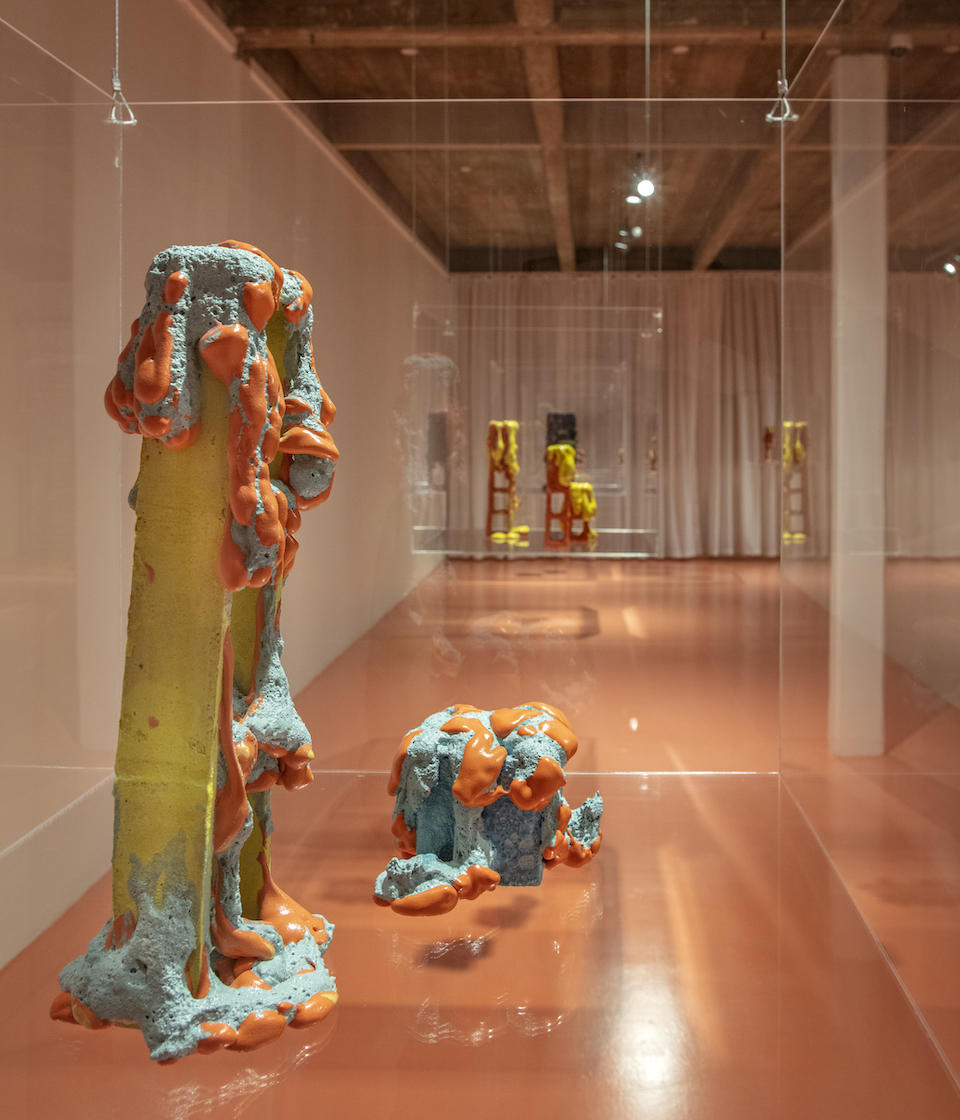
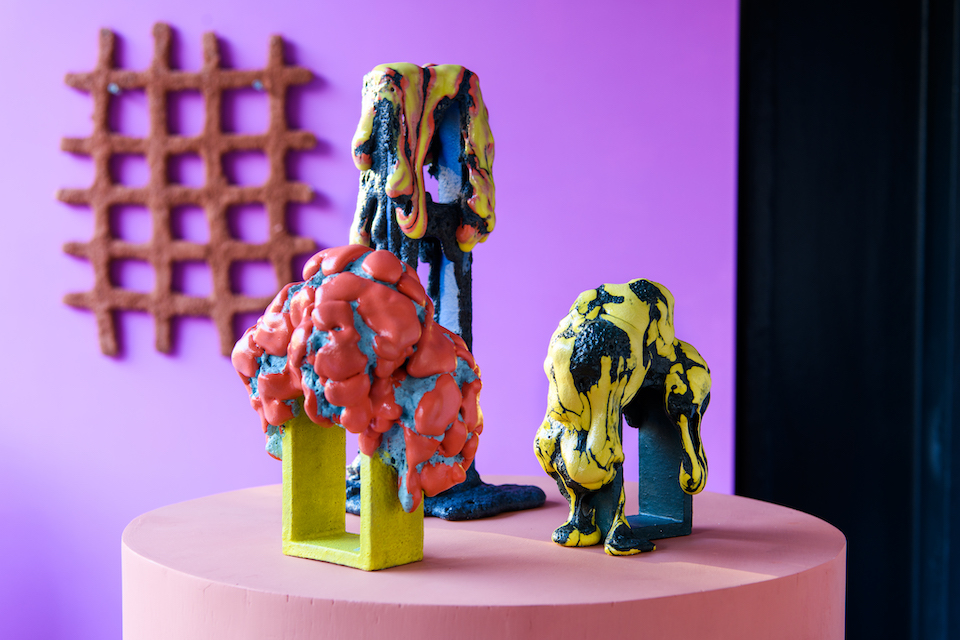
Her latest works are hallucinogenic landscape-like “sceneries”, in which animals made of plastic, fishhooks and objet trouvé porcelain figures appear. The figures have been taken from the children’s bedrooms or “found” in second-hand shops and they have been most deliberately dismantled from their original purposes and introduced into a new scenographic context. Landscape and elements collide, with the result that the frames of logic explode and the portals to the space of the dream and imaginative conceptual representation open up.

At the present exhibition, Gitte Jungersen is presenting her ceramic sculptures inside a staged space that engenders associations with Freud’s consulting room. Like events unfolding in “Alice in Wonderland”, we are invited through the looking glass and are presented to disquieting mental landscapes, cosmic regions and microworlds seen through the microscope. 

In one of the sceneries, for example, we see a barnyard pig, secured halfway in its cave, inside a shrill pink landscape. The pig’s potential lewdness is underscored by the scenery’s turgid growths. What we have here is a psycho-ceramic drama, which plays itself out on what is simultaneously an encrusted primeval landscape and a kinky-kitschy dreamscape.


A grayish “drain pipe” bespattered with sludge is hanging on the wall. What can be seen in the pipe’s mouth is a bellowing hippopotamus – an obscene scenery. Another wall scenery represents a yellow psychedelic landscape in the outermost galaxy with one rather amusing and alienated sheep. 

In a completely different vein, there is the scenery with a faience deer placed inside a fairy-tale magic circle of hyper-green growths. At first glance, what we see before us makes its appearance as a classical Arcadian, blissful landscape, which reminds us of life’s infinitude. We are familiar with these kinds of landscape representations as they appear in the history of porcelain, painting and ornamental gardening. However, the psychedelic colors in Jungersen’s landscape trigger associations with chemical leakage as well as with an alluring world of dreams, where latent danger is lurking about. The landscape is, at one and the same time, fairy-tale like and foreign.

With their bright colors and their bubbling and boiled texturality, the ceramic sculptures are extremely appealing at first glance. On closer inspection, however, what are being unfurled here are disquieting tales that circle around ambivalent psychic states of limbo situated between dream and reality, desire and repugnance, child-like innocence and adult sexuality … and also between primeval history and cyberspace. Often, the ceramic sceneries are all at once humorous and threatening in their exposition of general existential questions and problems.

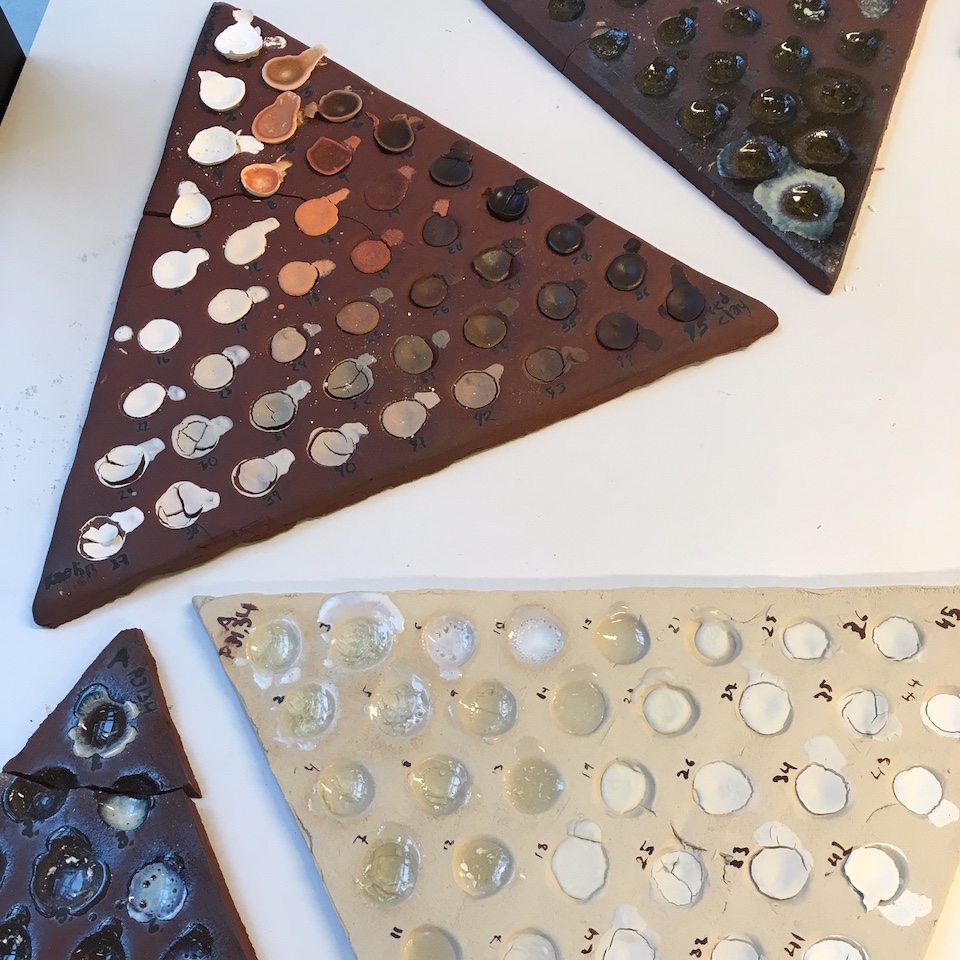
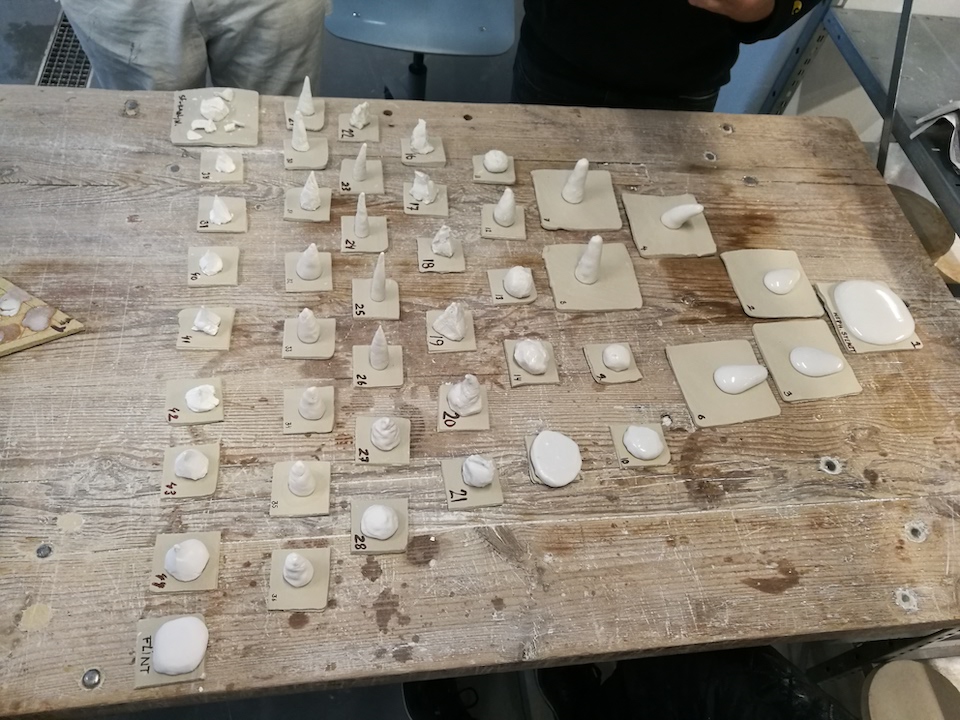
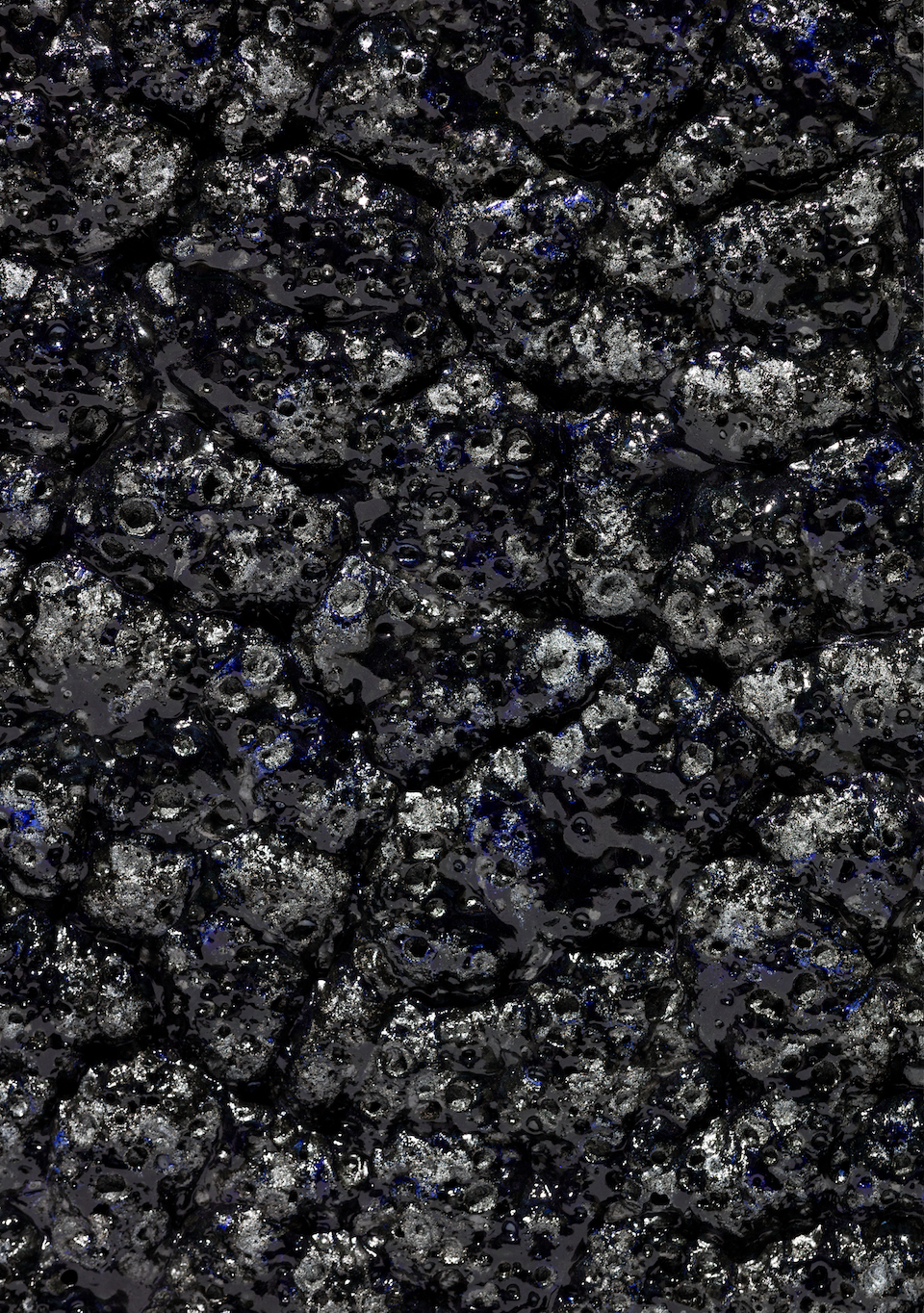
The super-textural landscapes look either like moon landscapes, volcanic formations or mushroom-like growth layers in hyper-real artificial colors. Jungersen has developed a special technique for creating the boiled and bubbled surfaces of glaze. Specifically, the bubbled surfaces come into being because the glaze is actually boiling when it is heated to a melting temperature of 1260 degrees Celsius. After attaining this temperature, it is suddenly cooled with the consequence that the bubbles are frozen solid. This spawns a very dramatic textural effect that can give rise to a sensation of playing witness to the forms’ chaotic origins and metamorphic processes – the border conditions between solid and fluid and between genesis and decomposition.

Clay has traditionally been regarded as a healing and amalgamating proto-material that can establish fertile soil for stabilizing forms in the midst of an alienating modernity. Ceramics has been linked to aesthetics, simplicity and authenticity – the unique work of art characterized by craftsmanship, which stood in diametrical opposition to industrialization’s anonymous products and Taylorized work forms. During the era of modernism, studio-made ceramics were largely concentrated around the formal: technical perfection; sublime mastery of the material and a formally aesthetic expression. Gitte Jungersen is a player on the younger ceramists’ scene who has consciously chosen to challenge ceramics’ traditions, both before and after modernism, with new techniques and artistic strategies. Her pieces are polysemantic conceptual works – which carry references to primeval history, fairytales, fables, pop, surrealism and science fiction. High culture and popular culture enter in on an equal footing in Jungersen’s works. In doing so, her pieces lay down a gauntlet before the trappings of “good taste”.

In a singularly wonderful way, Jungersen is linking up galaxies, dream scenes, everyday life and metamorphoses in her ceramic landscape sceneries. With a special signature admixture of childlike innocence, grotesque dreams, crack-brained weirdness and cosmic hallucinations, she is transforming the ceramic object into the stuff that dreams are made of. 

Rikke Rosenberg


Text written by Garth Johnson 2022. Johnson is the Paul Phillips and Sharon Sullivan Curator of Ceramics at the Everson Museum of Art, USA. Printed in a catalogue in connection with the exhibition “Ruin” in Officinet, Copenhagen.


Employing Agency

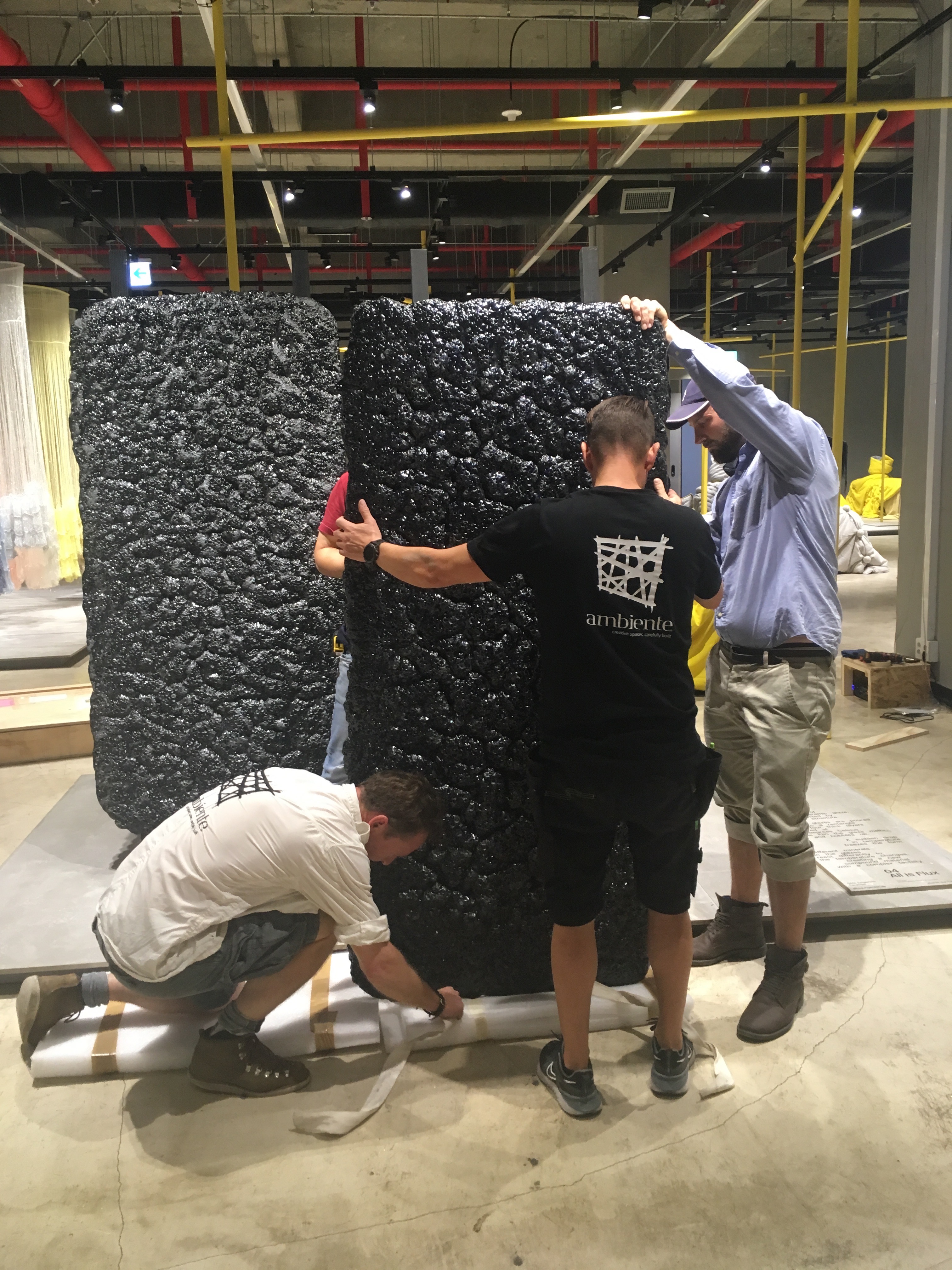
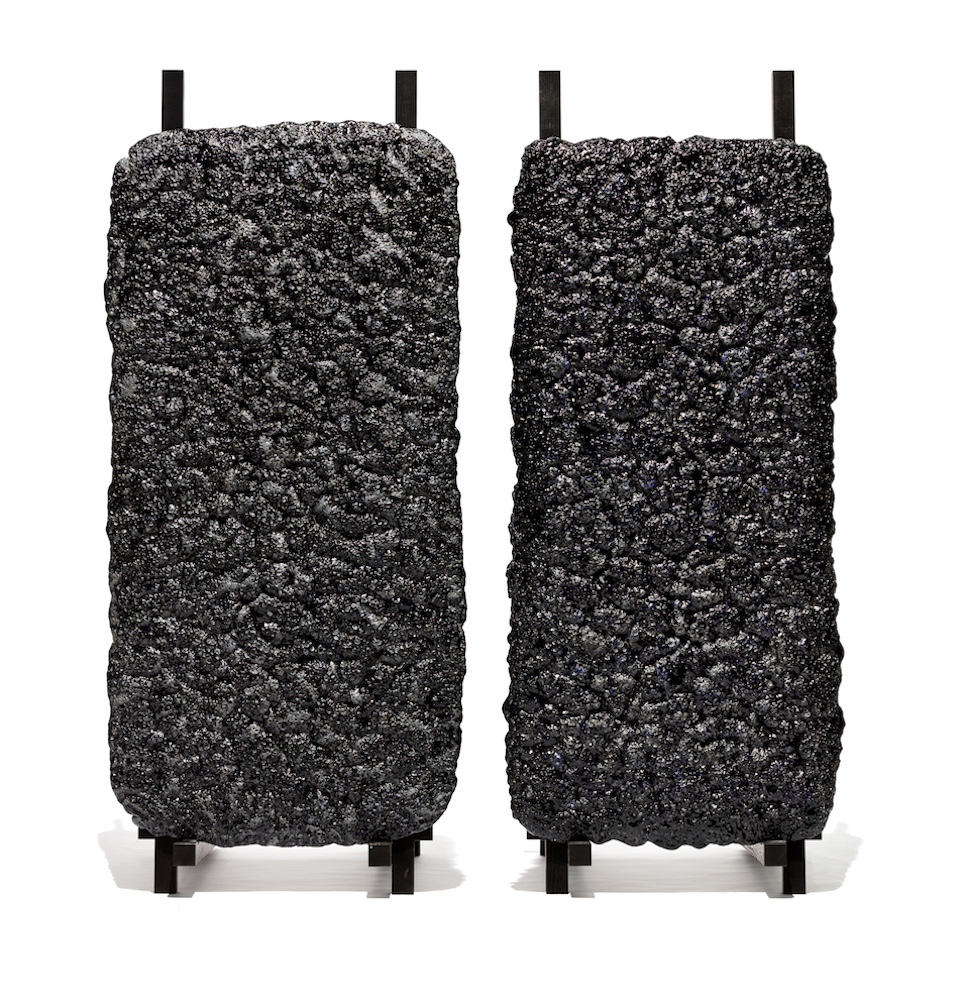
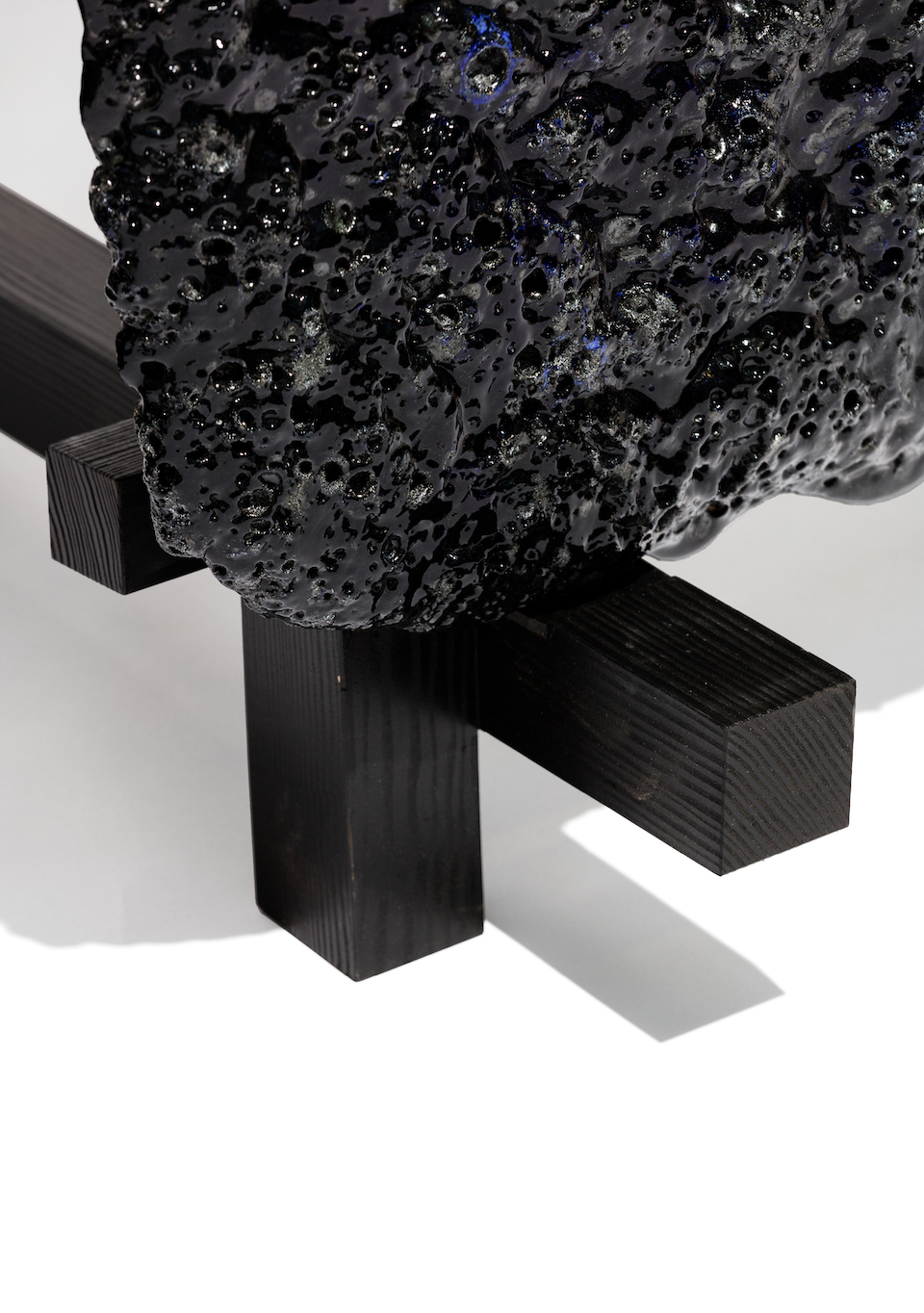
Gitte Jungersen’s monolithic glaze works All is Flux serve as something of a North Star for the works that have followed. All is Flux, begun in 2015, are a series of thick oozing slabs of glaze, untethered from any ceramic substrate. The resulting works, monumental in scale, mark a radical break from form (not to mention millennia of ceramic history), essentially creating dimensional tiles composed entirely of glaze.

All is Flux has precious few ancestors in the ceramic realm, but one that springs to mind is Robert Rauschenberg’s Mud Muse (1970), which currently resides in Stockholm’s Moderna Museet. Like All is FluxMud Muse is materiality stripped to its most primordial essence. Mud Muse consists of a large glass trough of bentonite clay, liquified to a pudding consistency. 64 sound-activated pneumatic tubes under the trough puff air into the viscous clay mixture, causing it to audibly bubble, occasionally offering up a splatter on the gallery floor.

For Rauschenberg, Mud Muse came at the tail end of a series of highly collaborative works starting with Oracle in 1966, another sound-activated piece consisting of four sculptural elements and an array of speakers that flip between five different radio stations as viewers interact with them. For all of the technological wizardry that makes Mud Muse possible, the piece can be reduced to its two most basic elements, clay and air. Importantly, Mud Muse also transfers the agency of the artist to the material, whose balletic roiling is controlled by ambient sound rather than steady streams or programmed pulses of air.

Questions of agency have long been central to Jungersen’s basic artistic proposition. On the global stage, Danish ceramists are quite unique. Because of Denmark’s strong design tradition, both in industry and education, there are ample opportunities to ground oneself in the fundamentals of design, as well as the opportunity to rebel against them. Ceramic artists of Jungersen’s generation are noted for pushing back against traditional notions of Danish design. Their work can be characterized by a deep sense of conceptual rigor, but a consequence of this is often a sense of self-doubt that is woven into the work. Jungersen, like many of her peers, constantly answers to an inner voice that asks:  Is this too pretty? Is this too commercial? Shouldn’t it be harder to do this? Has this been stripped down to its most essential elements?

Over the past four decades, Danish ceramists have found a plethora of delightful ways to overthink and outsmart their materials. Like Rauschenberg’s engineering of an autonomous device that cedes control of its material to sound waves and puffs of air, Danish artists have found ways to cede agency to outside forces. One of the most outré examples is Bente Skjøttgaard’s 2010 collaborative Hærvejen project that involved a herd of cows who gamely trampled a barn full of clay, which was then fired and installed in a field.

Put simply, the term agency refers to the state of acting or exerting power. A politician uses their agency to enact laws. An artist uses their agency to squish clay, chisel marble, or spread paint. It was only in the late 20th century that academics began fully investigating the idea of objects or artworks having their own agency. Theorizing about the agency of objects began in earnest in the field of anthropology. Ritual objects have agency over humans in that they can protect them from illness or evil spirits. Art historians followed, charting the many ways that aesthetic objects could exert agency over their owners.

It is only recently that theorists have begun to study the agency of materials themselves. As a material, clay’s physical properties make it unique. On a basic level, clay is a dance between gravity and moisture content. Wet clay will sag and droop on its own. Relatively dry clay will resist gravity but is vulnerable to instability and cracking. Less intuitively, clay has its own memory in that it will attempt to revert to its state before manipulation. Potters know that a teapot spout thrown on a wheel will often subtly unwind itself in the firing, which leads to the spout leaning to one side or the other. 

Yet another layer of agency belongs to the firing process. Increasingly, artists have precise control over temperature and the atmosphere within the kiln, but traditionally, these factors were hard to control because of kiln irregularities and the vagaries of learning to judge temperature through the color and velocity of the fire. More often than not, failure to control the factors in a firing led to technical or aesthetic deficiencies in the work, but occasionally, serendipity delivered a “gift from the fire.” Many serious ceramists spend a considerable part of their careers trying to replicate the conditions that delivered these “gifts.”

Potters throughout history have struggled against the agency of clay and fire, but in the modern era, artists who work with clay have delighted in ceding at least some of their agency to the firing process, or even to the material itself. French art potters in the late 19th century like Ernest Chaplet and Auguste Delaherche delighted in loading grand feu porcelain works with a veritable bouillabaisse of polychrome glazes that, when the kiln gods were on their side, expressively commingled to create passionate, primordial surfaces. Artist Niels Hansen Jacobsen worked alongside these French masters in Paris and is the prime suspect for importing lava glaze to Denmark, which he used to wild effect.

Because of its unpredictability, lava glaze, with its fizzy craters and runny texture, possesses more agency than most ceramic materials. Because it expands, it obscures not only the marks of the potter’s hands—it coats the ceramic form, obscuring nearly all of the qualities of the clay body itself. Although lava glaze found its most fertile ground in Germany, it was also a part of the midcentury Danish design vocabulary and was even used occasionally by studio potters like Gutte Eriksen.

In the experimental artistic propositions of Jungersen, Lava glaze is taken to new heights. Since the 1990s, when Jungersen covered geometric forms with ash and lava glazes for her Cubes and Boxes series, she has gradually developed strategies to cede more and more agency to her materials. The designerly strategy that made lava glaze so prevalent in the midcentury era was pairing the unpredictable glaze with a simple form in a bold silhouette. For her early works, Jungersen doubled down on that strategy, substituting modernist curves for Brutalist cubes.

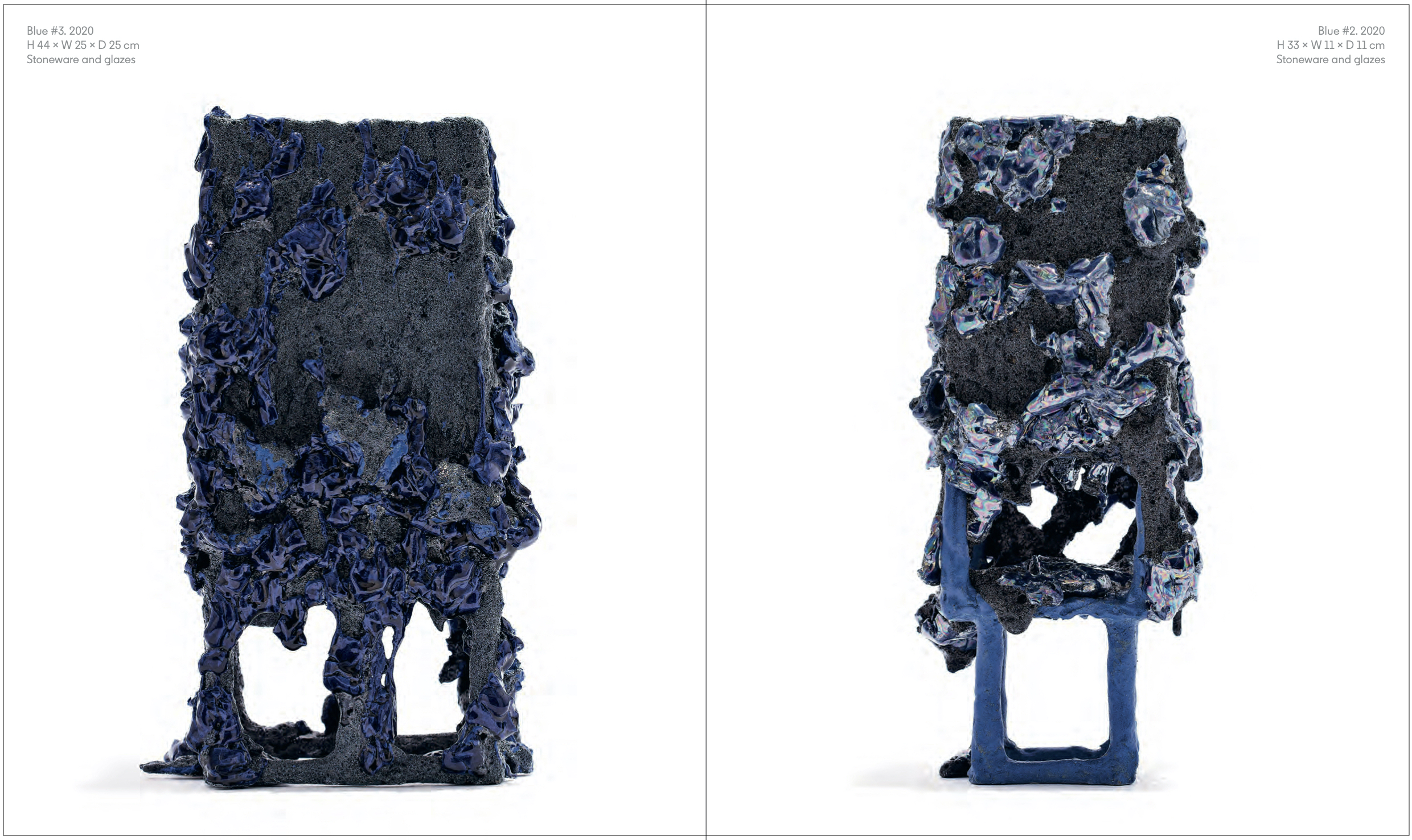
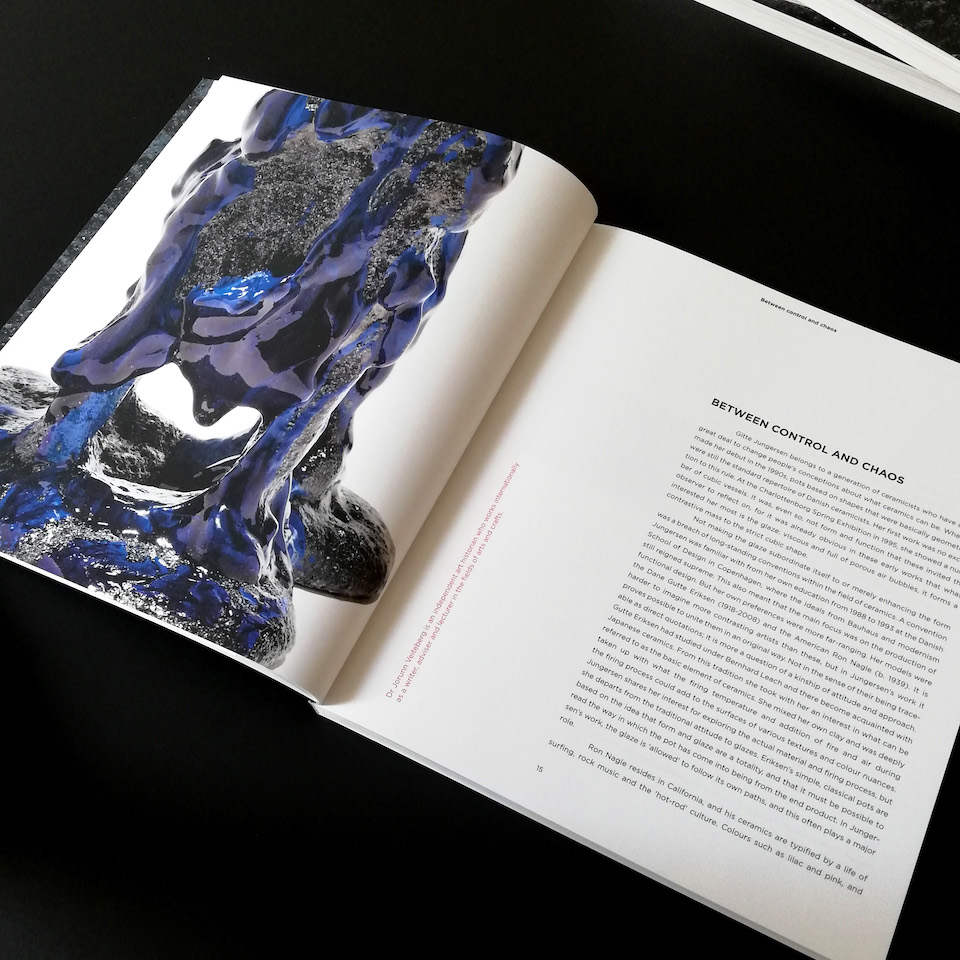

The dichotomy between unyielding geometric forms and unpredictable glazes are a through line for Jungersen. Her newest body of work includes variations on this theme, but deeply informed by her material experiments from All is Flux. An extended residency at the Danish Art Workshops, with its large kilns, allowed Jungersen to raise the stakes considerably, creating a series of large open-ended cubes covered in her deepest blue lava glaze. With their open tops, the cubes become vessels, allowing for an immense accumulation of glaze material to pool in their interior. These interior landscapes allow for the viewer to reflect on their relationships with grottoes and other mediated landscapes. 

In addition to their scale, these works take the transfer of agency to the materials to new heights. Never one to leave a feature of her work unexploited, this time Jungersen took advantage of the relationship between the increased mass of her work and its relationship with gravity. Placing a large ceramic cube on spindly legs would be a technically audacious move for any ceramist, but for Jungersen, it represents a high-risk, high-reward proposition. Before the piece went in the kiln, Jungersen was essentially placing a bet that the weight of the piece would cause significant pyroplastic deformation, and would bend the legs in intriguing ways, but not result in the total destruction of the piece.

Despite working up to her final firing deadline, Jungersen’s bet paid off. In Ruin #1, the legs managed to torque, twisting the cube counterclockwise while maintaining at least a degree of stability. This dance of destruction between artist and material might not be apparent to every viewer, but the power and dynamism of the piece will certainly stand on its own. With shorter “legs,” Ruin #2 is less ambitious when it comes to self-destructive potential. What it may lack in structural drama, it more than makes up for in the richness of its surface. Ruin #2 is among the most successful experimental surfaces to ever emerge from Jungersen’s kiln. Inside and out, this vessel is riven with brilliant blue ribbons of glaze that burrow like lichen into the volcanic surface. 

Ruin #3 is a summation of the project—and a confirmation that Jungersen’s searching and self-doubt in the studio yields serious results. She confesses that after two firings, the results seemed a bit too “nice,” so obviously, a third firing was in order. If Jungersen’s aim was to push beyond “nice,” the third firing certainly accomplished its mission. In this firing, the piece’s fatigued legs collapsed completely. Fate and gravity led the cube-like vessel to come to rest on one point at a nearly perfect 45-degree angle. Taken as a group, the three Ruin sculptures show how Jungersen can use her stubborn nature to tease a wide variety of outcomes from a seemingly narrow set of variables.

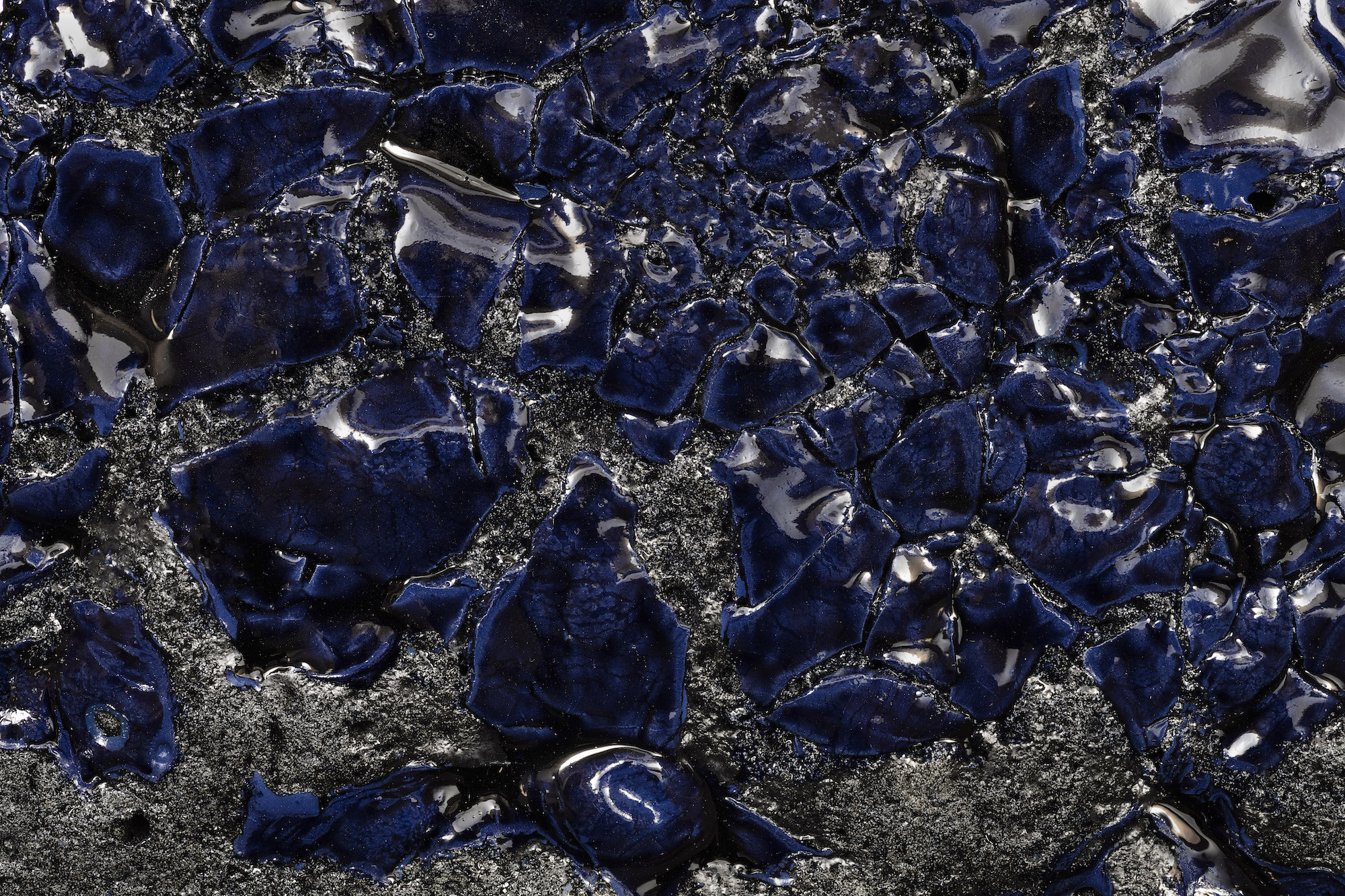
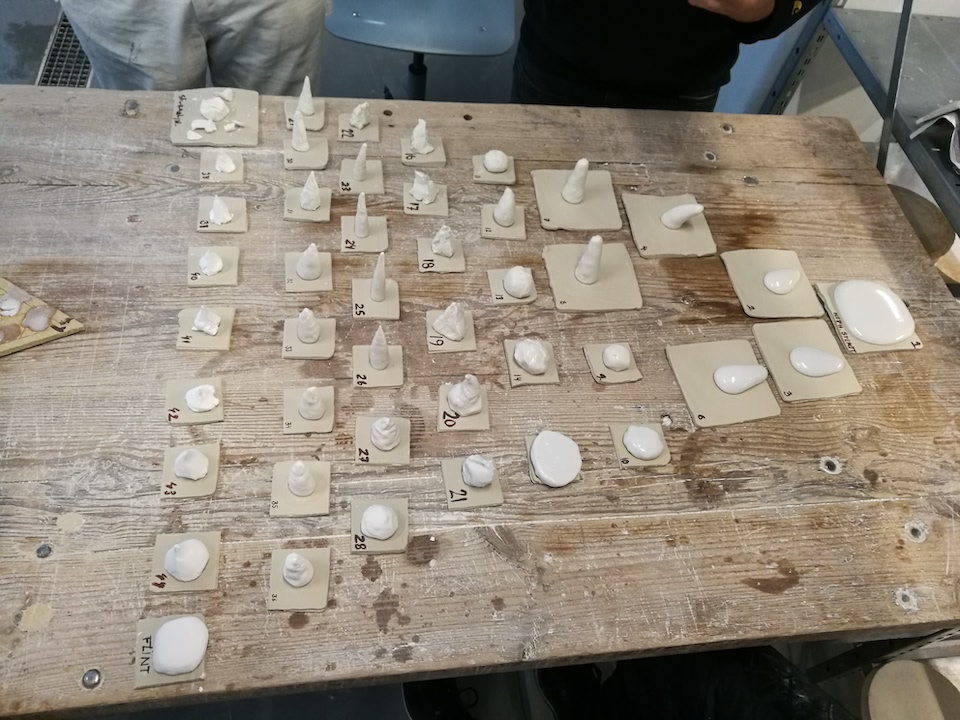
These thoughts are built around the idea of transferring agency to materials, but I don’t want to minimize Jungersen’s careful observations that she has gleaned from nearly three decades of experiments. From the All is Flux series, she met the challenge of making her glazes function autonomously by dialing in her surfaces and layering glazes that stretch a delicate “skin” across the dramatic lava glaze. In a playful wink that provides an ethereal counterpoint to the primordial ooze of her glazes, Jungersen often coats that top film of glaze with pearlescent luster. The luster, which is normally found on debased tchotchkes and dime store figurines, becomes weightless and transcendent, akin to a soap bubble… or perhaps more aptly, the psychedelic rainbow atop a toxic oil slick.

These vessels contain multitudes. Glaze is a language that for centuries has remained relatively static. Is the glaze still, or is it fluid? Is it shiny, or is it matte? Is it monochrome, or polychrome? In Jungersen’s hands, the glaze has an almost infinite lexicon of expression. It is all of the above, but it is also dimensional, chunking, flaking, peeling, crinkling, and crawling—often within the same piece. It is the combination of a career spent carefully experimenting and taking notes, but also a fearlessness and appetite for risk that has only grown with time. This body of work is momentous because it represents a full range of Jungersen’s creative output, stripped to the essentials of form and glaze, but carefully calibrated to balance the agency of the artist and that of her materials.

RUIN

The classic exhibition space at Officinet* has been transformed into a rough construction-site version of ‘the white cube’. A scaffolding net adds contrast and creates its own room within the room. Through the net, visitors glimpse bits and pieces from the exhibition construction: dismantled transport crates, a ladder, an abandoned folding rule … Playing with impressions, the scenario suggests that the exhibition has only just been unpacked or is perhaps in the process of being packed up. This uncertainty sows doubt about the stability of the exhibition situation itself and underscores the processual character of the exhibition pieces. 

A Quivering Undertone

The objects in the Ruin exhibition were created during a residency at the Danish Art Workshops in autumn 2022. In a sense, Ruin is a continuation of former series of works, but this time, I have returned to the scene of the crime with a different approach. The objects refer at once to the familiar ceramic archetype of the vessel and to a more open, abstract structure that sparks associations pointing in many different directions. To a ceramic artist, the vessel is almost like the painter’s white canvas: a starting point that can be reinterpreted over and over in a search for new and contemporary expressions. I previously worked with cubic vessels, their simple shape providing a basis for the organic movements of glazes (the Cubes series, 1995–2007). Another project that this exhibition draws on is Deform from 1995–97. It consisted of a series of basic geometric shapes that were exposed to ever higher temperatures, causing them increasingly to melt and transition towards something formless and lumpy. 

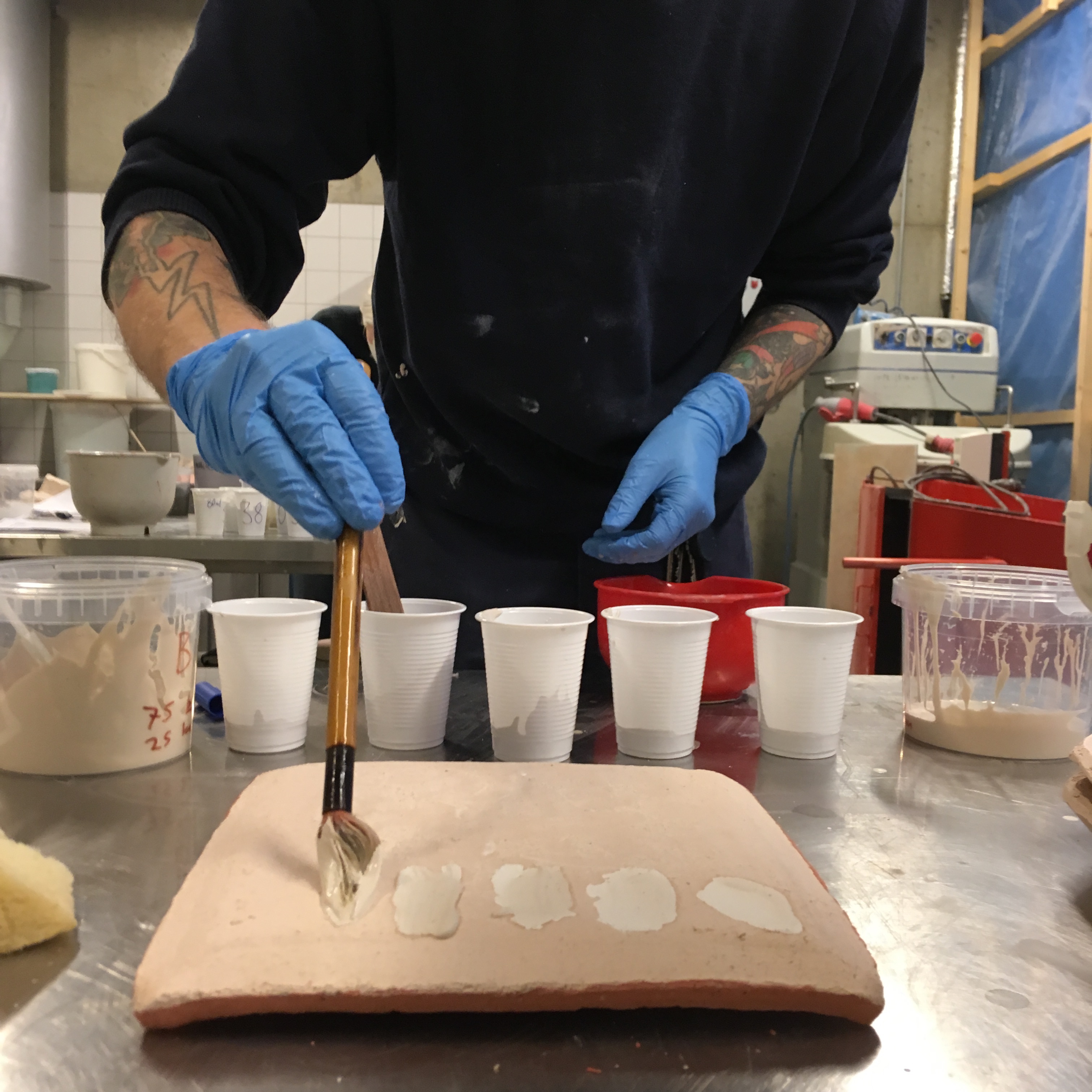
My work on Ruin unfolded as one big experiment, as I chose to maximize the loss of control that the firing always represents in the ceramic process, where melting is a crucial factor in the emergence of the expression. I let the glazes flow freely, virtually dissolving the surfaces as they slid down the form. I also pushed the shape of the objects to the point of compromising their integrity, causing some of them to deform and come close to collapse. In many of the objects in this series, the vessel’s inner cavity is just as significant as its exterior form due to the mass of glaze flowing down the inner walls and creating the impression of a landscape or a grotto inside the object. These massive layers of glaze create an expression reminiscent of geological processes, and to me, the objects occupy a position in between the raw powers of nature and man-made cultural objects. 

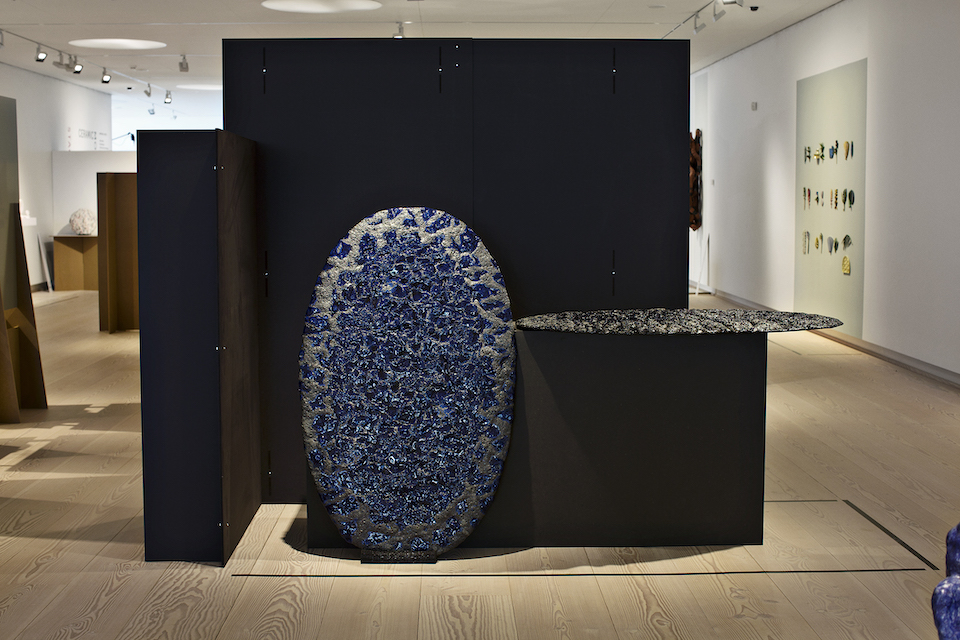
All the glazes are coloured with cobalt oxide, a politically ‘hot’ metal that is used in lithium ion batteries and hence a highly sought-after and limited resource. In the chemical composition of the different glazes, the cobalt unfolded in varying shades of colour and texture, ranging from a greyish blue lava-like mass to a deep blue high-gloss shine. In ceramics, cobalt is known from the time of the Chinese Tang Dynasty in the 7th century and all the way up to today’s blue fluted porcelain. In a glaze, cobalt oxide can result in anything from a cheap ingratiating tone to an aristocratic blue.

In my approach to ceramics, the material is constantly exposed – there is constantly something happening to it, and the objects emerge as an accumulation of processes that are deposited as a representation of energy and time in the physical matter. I pushed the forms and glazes to the edge of what is possible, building too tall and spindly, too big and thin, firing at too high a temperature. I covered the objects with huge amounts of different glazes, sometimes layering glazes with opposite physical properties: some layers bubbling up and expanding, others contracting into flakes or running and pooling into deep lakes. I fired objects multiple times, added new layers of glaze and then fired them again at a higher temperature, driving the object to ever higher levels of deformation. I did not stop until an object had attained a certain quivering expression, teetering on the edge between creation and destruction. The objects may appear to be in a transformative process, representing a tangible point on the object’s timeline, since just as there is a ‘before’, there will also be an ‘after’. Ultimately, the objects are going to break up completely, dissolve and enter into new physical manifestations.

Thank you to the Danish Arts Foundation!

The Danish Arts Foundation awarded me a very generous work grant this year, thank you!

The foundation’s motivation: Ceramicist Gitte Jungersen is centrally placed in her professional field and expresses herself artistically in a fierce and present language that understands and continually challenges essential ceramic forces. Earth, chemistry, temperatures and gravity in constellations causing respective transformation, decomposition, dissolution and entirely new connections. You feel that you are facing something eternal when you encounter Jungersen’s experimental art. Whether you are out in the distant galaxies with black holes, or in a muddy flood of man-made constructions or simply staring at a bubbling congealed glaze surface, you are overwhelmed by raw beauty and insistent creative power. Many years of impressive work with glaze combinations and experiments with firing techniques have shown that Gitte Jungersen creates her very own characteristic structures, surfaces and colours.

https://www.kunst.dk/214-kunsthaandvaerkere-og-designere-modtager-arbejdslegater/gitte-jungersen

Duo exhibition in Peach Corner

Press release:

There is constantly something happening

Caroline Slotte (FI) and Gitte Jungersen (DK) 13 April – 20 May 2023

Pernille Stockmarr, curator at Designmuseum Danmark, gives the opening address at 17.00

Ceramics can be transformed in a split second if they are accidentally dropped and shatter. Or they can be slowly worn down – touched by hands, scratched by cutlery, their surface eroded by wind and weather. From the moment of creation, any object is also an incipient ruin, since, just as there is a ‘before’, there will also be an ‘after’. Over time, the objects are going to break up completely and enter into new physical manifestations.

Caroline Slotte’s works begin with antique porcelain plates. She sandblasts, grinds and cuts her way into the materi-
al, bringing new poetic images out of the familiar utilitarian objects. In her series Tracing, a miniature sandstorm has swept the original pieces, removing layer after layer of material. A landscape painted in cobalt blue, a sky, a cloud, a tiny person – the image is slowly eroded away, turning into white dust on the workshop floor. The flat blue painted scene gradually transforms into something akin to an imprint or an X-ray image, as if a memory of the image had sunk into the surface and is now slowly emerging as a three-dimensional recollection. In Under Blue Skies, all that remains is a few blue clouds. The clouds, which were originally added as background on the outer edge of the central image, move to the foreground, now accompanied by an outline of the elements that have been eroded away: a church, a tree, a floral border. The vanished areas can be glimpsed as negative forms in the white porcelain body.

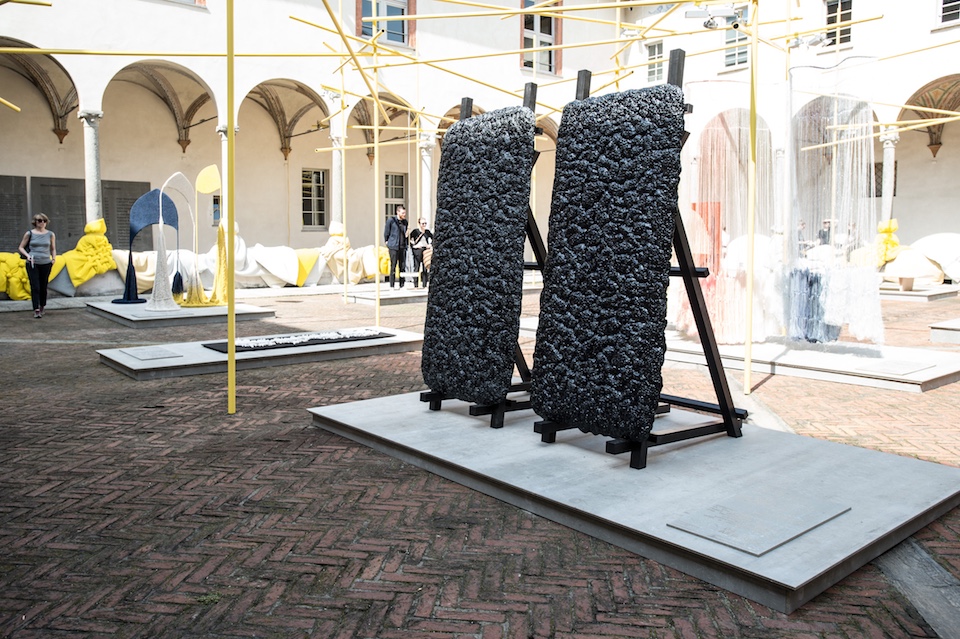
In Gitte Jungersen’s large glaze objects, creation and destruction seem like two extremes that are closely connected. Piece #2 and Piece #3 consist of different glazes poured out in thick layers. Usually, even on a large sculpture, the glaze is only present as a thin layer, but here, the glazes take on a format that mirrors the human body. Like a blown-up detail or something seen through a microscope. All the glazes are coloured with cobalt oxide, which in the chemical make-up of the different glazes unfolds in varying colour shades and textures, from a greyish blue lava-like mass to a deep blue high-gloss shine. Glaze comes into being when different raw minerals coalesce and transform, becoming something new as a result of the firing’s dramatic, destructive and disintegrating forces. The transformation which occurs during the firing is retained as a frozen moment of a dynamic dimension that is felt and attracts like a quivering undertone in the finished work.

Residency at the Danish Art Workshops

During the next three months I will be working at the Danish Art workshops. I will develop works for a solo show in Officinet, a projectspace in Copenhagen, and for a duo exhibition together with Caroline Slotte (Finland) in Format Oslo. My residency and the solo exhibition is generously supported by Danish Arts Foundation, Esther og Jep Finks Mindefond og Beckett Fonden.


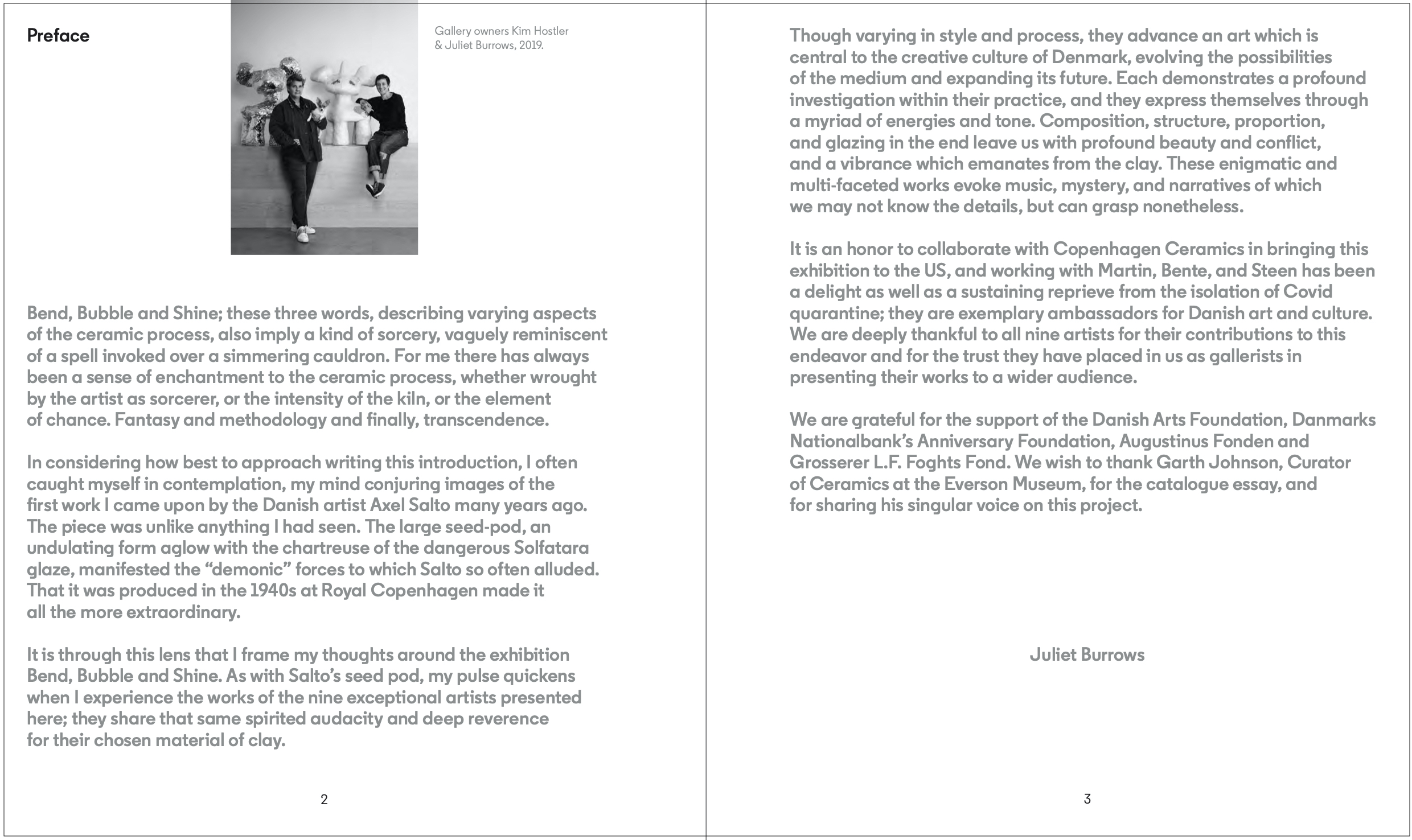
Bend, Bubble and Shine at Hostler Burrows New York

May 2021. New York, NY – Hostler Burrows is pleased to announce Bend, Bubble and Shine: Copenhagen Ceramics at Hostler Burrows, a group exhibition in concert with Copenhagen Ceramics. The exhibition celebrates the work of nine Danish studio ceramic artists working at the forefront of their discipline, exploring technique and process with original, surprising and intriguing results. Artists to be included: Karen Bennicke, Morten Løbner Espersen, Steen Ipsen, Gitte Jungersen, Martin Bodilsen Kaldahl, Marianne Nielsen,Turi Heisselberg Pedersen, Pernille Pontoppidan Pedersen, and Bente Skjøttgaard.

The exhibition will run from April 29 through June 10, 2021 at Hostler Burrows New York, after which it will travel to Hostler Burrows Los Angeles with dates to be announced.
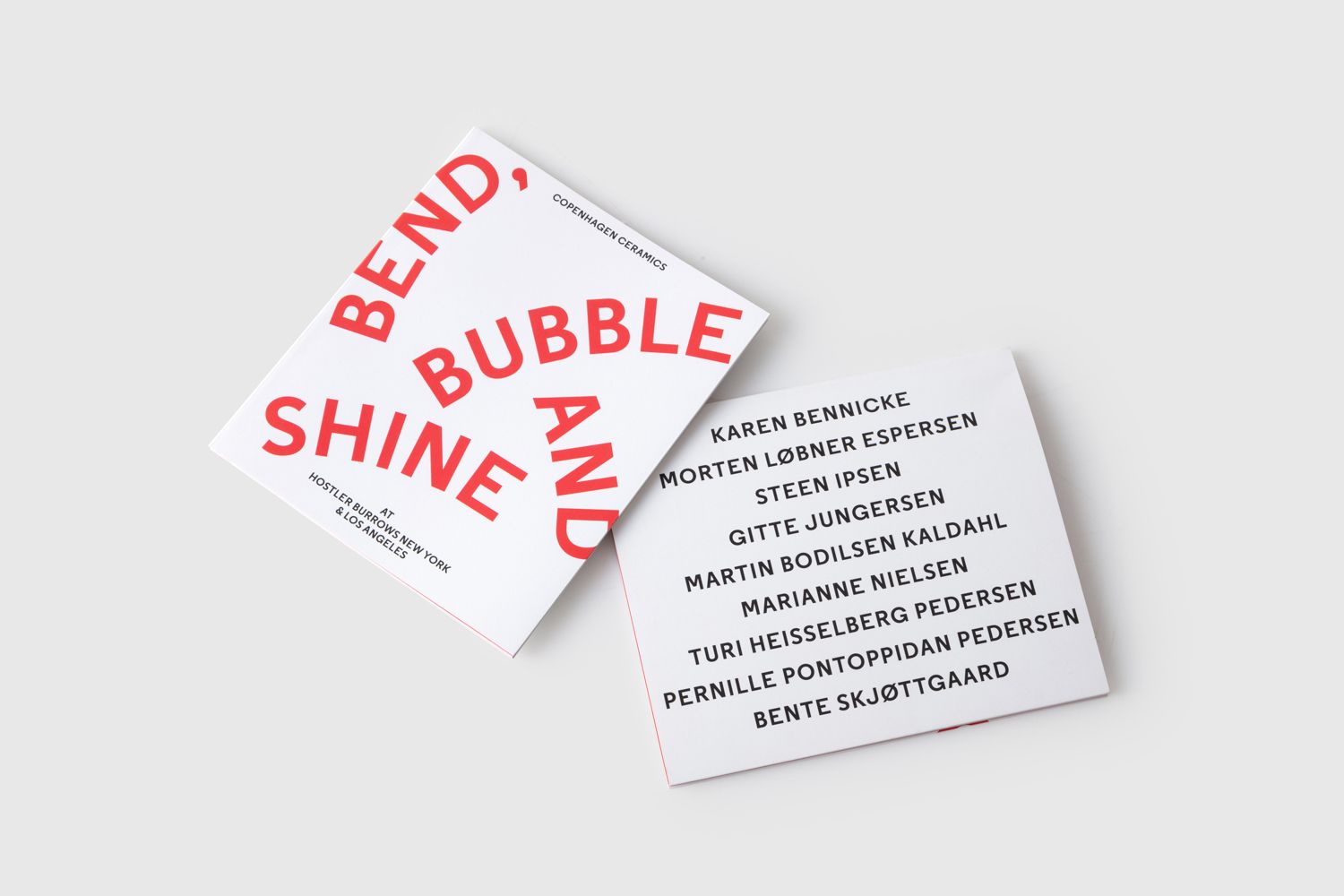
 

Bend, Bubble and Shine: Copenhagen Ceramics at Hostler Burrows
Exhibition Catalog
With essays by Martin Bodilsen Kaldahl, Garth Johnson and preface by Juliet Burrows
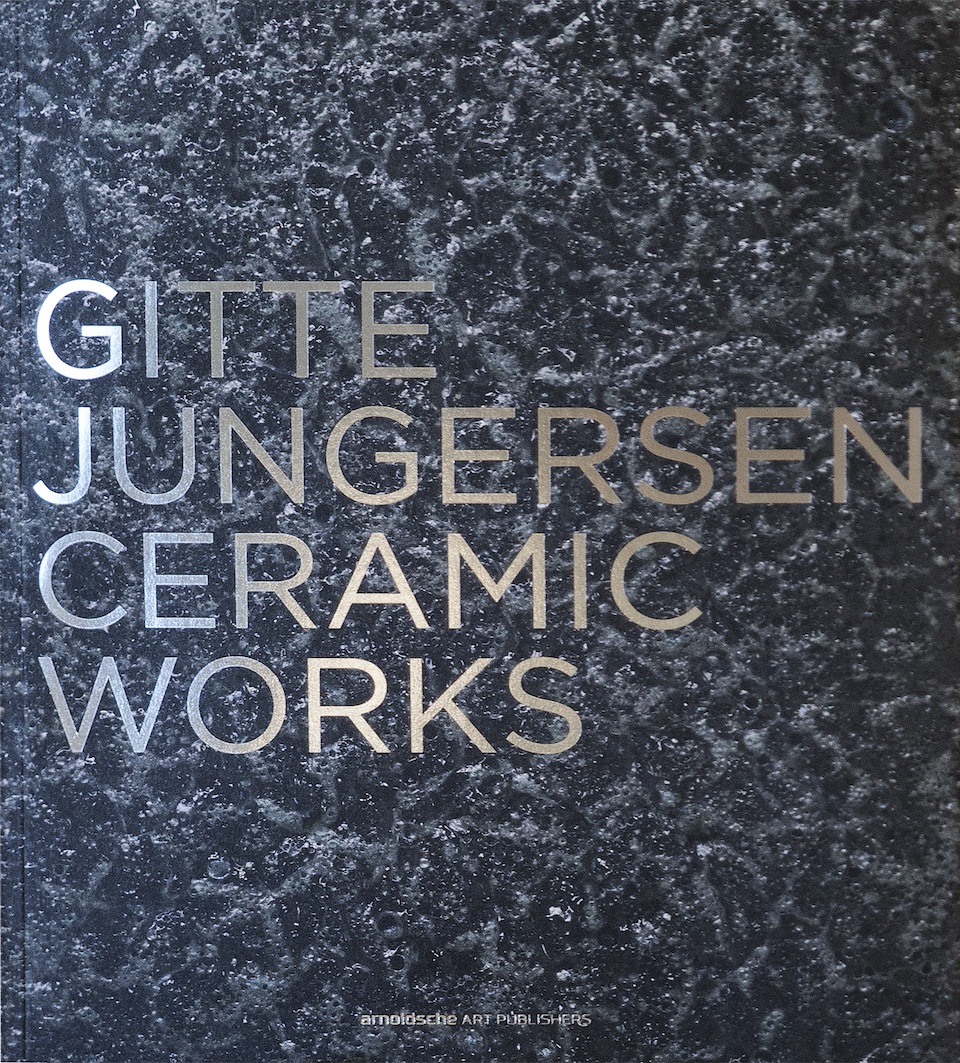
Hardcover / 30 pages / 16.5 x 23.4 inches / 32 color illustrations, including 1 gatefold / Published by Copenhagen Ceramics / April 2021


Danmarks Nationalbank’s Appreciation Grant

December 2020. Danmarks Nationalbank Jubilee Foundation has awarded me the appreciation grant.

The foundation motivates the grant with the following words:
“Your starting point is very classic ceramic, intuitive and sensual, but then you shift gears, and squeeze your work into precisely conceived concepts, which are fresh and innovative for the work with the ceramic materials. You have more than pretty good control over how you stage and partially controls the chaos you seek. Because it will become chaos when you work with glazes in such huge amounts as you do. And of course it is part of the point that you can only to some degree control the chaos, and thus you let the glaze define the work. Your works are radical and ground breaking, and you let the vivid, and for ceramics unusual, primary colours dominate and draw the hardcore classic pottery up off the couch. Your works are experimental and one of the strengths of your work is that it always surprises the viewer, and goes new ways. You are constantly moving forward, towards something new, something different, something yet more extreme. Or completely silent. Who knows? The foundation hopes that with this grant you will have the opportunity to maintain both freedom, quality and enthusiasm for more exciting projects.”